AI Digest
APRIL 2026
~ ~ \\ // ~ ~
authored by
Jerry Gonzalez
09 APR 2026
Copyright (C) SAFE AI Foundation
'What Our Legal Battles with AI Reveal About Us?'
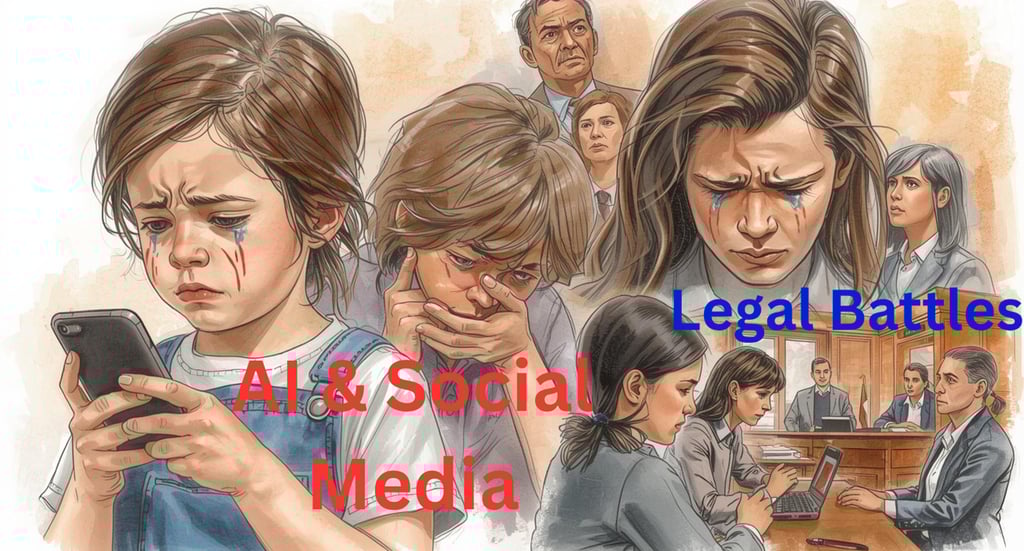
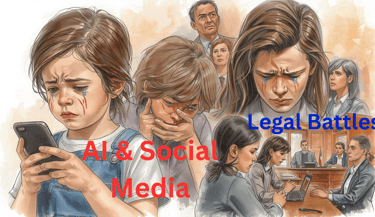
We often ask what AI can do. Perhaps the more important question is what it is revealing about us.
It is difficult not to notice the growing number of legal battles surrounding what we call “Big Tech.” Yet perhaps the more interesting question is not who is being challenged in court, but what these moments begin to suggest about the relationship between technology and human values.
Again and again, similar themes seem to emerge:
Meta facing a class action lawsuit over the use of personal data to train AI systems without consent
Meta and Google losing a U.S. case concerning the social harms experienced by children
Meta, Nvidia and Roblox being sued by 3D artists over the use of their work in AI training
A Los Angeles County Superior Court case examining whether Meta and Google may be held liable for mental health harms
And so, one begins to wonder: are these merely isolated legal disputes or are they reflections of a deeper tension between human values and the systems we are so eagerly creating?
Social media has been with us long enough for its patterns to become familiar. It connects, and yet it isolates. It informs, and yet it can distort. For some, especially the young, it becomes less a tool and more an environment, one that shapes attention, relationships, and even identity. Issues such as overuse, dependency, and online harm are not new, but neither have they disappeared.
With the arrival of AI, these dynamics seem not to have changed in nature, but in scale and subtlety. The ability to precisely target individuals, guiding attention, influencing choices, and shaping behavior, has become more refined and almost invisible.
There is also the question of creation itself. Many AI systems are trained on vast amounts of personal and copyrighted data, often without the awareness of those who created it. This tension has already surfaced in legal form, as seen in the lawsuit brought by artists against Meta, Nvidia, and Roblox for using their work in AI training.
One might ask, when a machine learns from human expression, where does ownership truly reside?
Yet there are moments when the outcome moves in a different direction. In one case, a court dismissed a lawsuit concerning the use of copyrighted books for AI training. The judge reasoned that the model did not reproduce or provide meaningful access to the original works in a way that would violate copyright.
And still, a quiet tension remains. Authors have expressed concern that such decisions may affect book sales and future licensing opportunities for AI training. The ruling itself was careful and limited in scope, applying only to that specific case and not declaring all uses of copyrighted material for AI training to be lawful.
This leaves an open question that feels less legal and more human. If a system learns from the work of many and is later used to generate profit, what becomes of the original creator’s contribution? And in such a landscape, how do we begin to think about fairness, ownership, and value?
There have also been cases where the use of chatbots has led to deeply troubling outcomes. These range from overuse and dependency to misinformation, and in more severe instances, consequences such as self-harm or real-world harm. While each case is different, together they point to something that cannot be easily dismissed.
It is tempting to ask whether such outcomes could have been prevented. Perhaps the more meaningful question is why they were not anticipated more fully. Any product that shapes human thought, behavior, or emotion carries with it a responsibility to be examined with care. This includes not only intended use, but also possible misuse, potential risks, and unintended side effects.
And yet, in the urgency to move quickly and lead in what is often described as an AI race, these deeper considerations can be set aside. But speed does not dissolve responsibility. If anything, it makes the need for thoughtful design and careful evaluation even more essential.
It can seem curious that so much time and energy are spent responding to legal challenges, often after the harm has already surfaced, rather than in carefully examining these systems before they are released into the world. This invites a deeper question, not only about companies, but about the pace and priorities we have come to accept.
And yet, there is also something reassuring in the presence of a legal system that can still call these matters into question, bringing different voices into the same space to seek clarity and resolution. For those who bring the claims, it is often about justice, compensation, and a sense of acknowledgment. For those who are called to respond, it may become an opportunity to reflect, to learn, and perhaps to act differently moving forward.
In the end, these moments are not only about accountability, but about how we choose to shape the relationship between human values and the technologies we continue to create.
~~~ end ~~~
About the Author:
Jerry Gonzalez is a Data Scientist, Director of North America and a proud supporter of the SAFE AI Foundation. He holds a Master's Degree in Information and Data Science from U C Berkeley, USA.
REFEERENCES
REUTERS NEWS - Meta, Google lose US case over social media harm to kids -https://www.reuters.com/legal/litigation/jury-reaches-verdict-meta-google-trial-social-media-addiction-2026-03-25/
REUTERS NEWS - Meta, Nvidia, Roblox sued by 3D artist over AI training, https://www.reuters.com/legal/government/meta-nvidia-roblox-sued-by-3d-artist-over-ai-training-2026-03-26/
WIKIPEDIA – Deaths linked to Chatbots. See: https://en.wikipedia.org/wiki/Deaths_linked_to_chatbots
Court Dismisses Lawsuit Against Meta Over Use of AI Training - https://www.ksclawyers.com/court-dismisses-lawsuit-against-meta-over-use-of-ai-training/
Disclaimer: The information in this digest is provided “as it is”, by the SAFE AI FOUNDATION, USA. The use of the information provided here is subject to the user’s own risk, accountability, and responsibility. The SAFE AI FOUNDATION and the author are not responsible for the use of the information by the user or reader. All copyrights related to this article are reserved by the author. Please reference this article if you wish to cite it elsewhere.
Note: The SAFE AI Foundation is a non-profit organization registered in the State of California and it welcomes inputs and feedback from readers and the public. If you have things to add concerning AI Ethics or AI safety compliance and would like to volunteer or donate, please email us at: contact@safeaifoundation.com