
AI Digest
JUNE / JULY 2026
~ ~ \\ // ~ ~
authored by
Nirmal Kumar Jingar
(Wayfair Inc.)
20 APR 2026
Copyright (C) SAFE AI Foundation
'AI in Logistics'
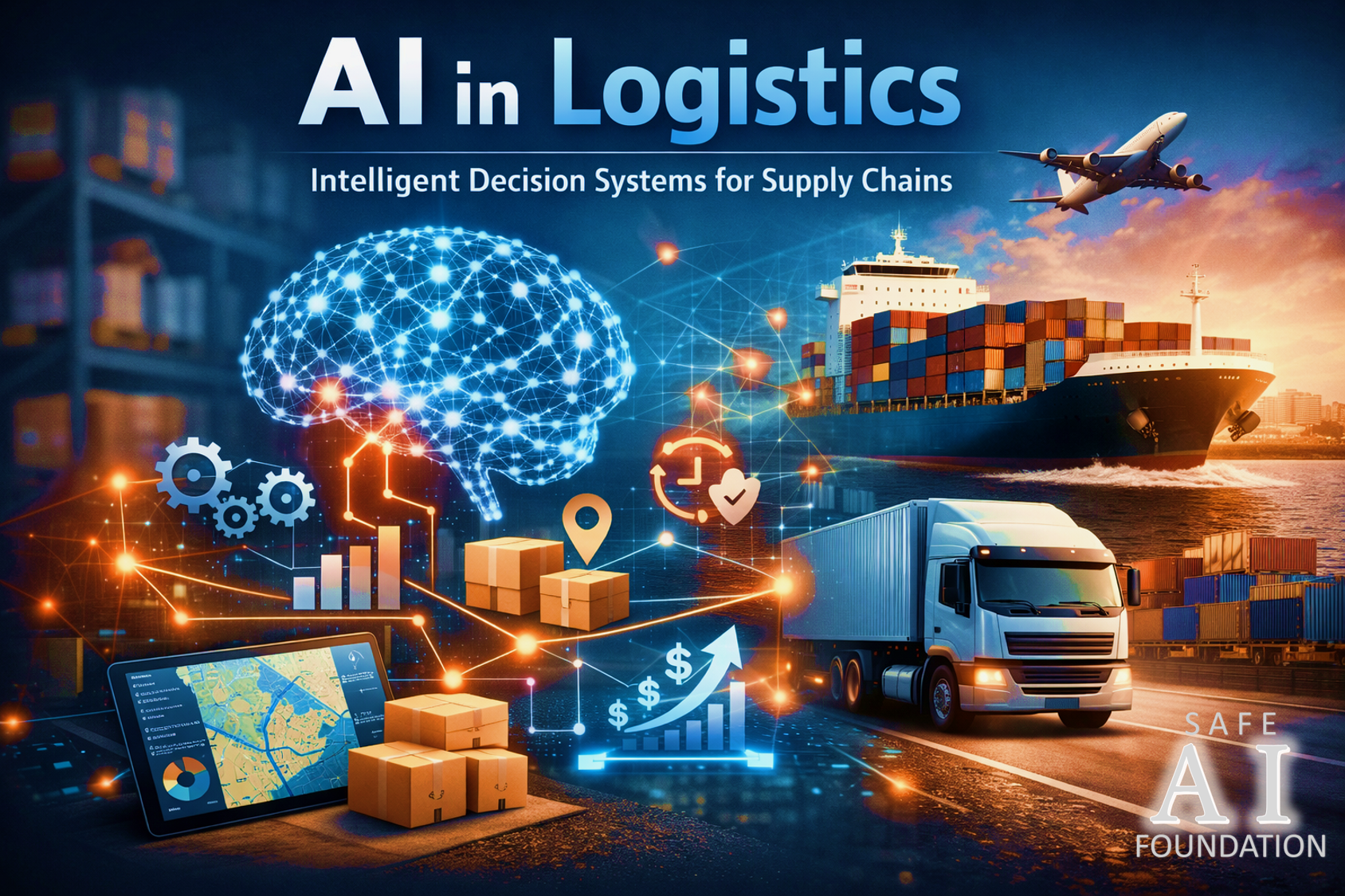
Logistics has always been a discipline of precision. The goal is simple on the surface, move goods from one place to another efficiently. In practice, it is one of the most complex decision environments in any industry. Every movement involves tradeoffs between cost, speed, capacity, and customer experience.
What is changing now is not just the scale of logistics, but the way decisions are made. AI is shifting the focus from task automation to intelligent decision systems that operate across the entire lifecycle of operations.
The right way to think about AI in logistics is not as a universal solution, but as a targeted capability. AI should be used when decisions require evaluating many variables at once, when conditions change frequently, or when outcomes benefit from continuous learning. This includes areas such as:
Dynamic routing
Demand forecasting
Capacity planning
Exception handling
AI agents extend this further. They are useful when decisions need to be executed autonomously across systems, not just recommended. Agents can monitor signals, trigger workflows, and coordinate actions across services. This is particularly effective in scenarios like real time rerouting, disruption management, and automated recovery workflows where speed and consistency matter more than manual control.
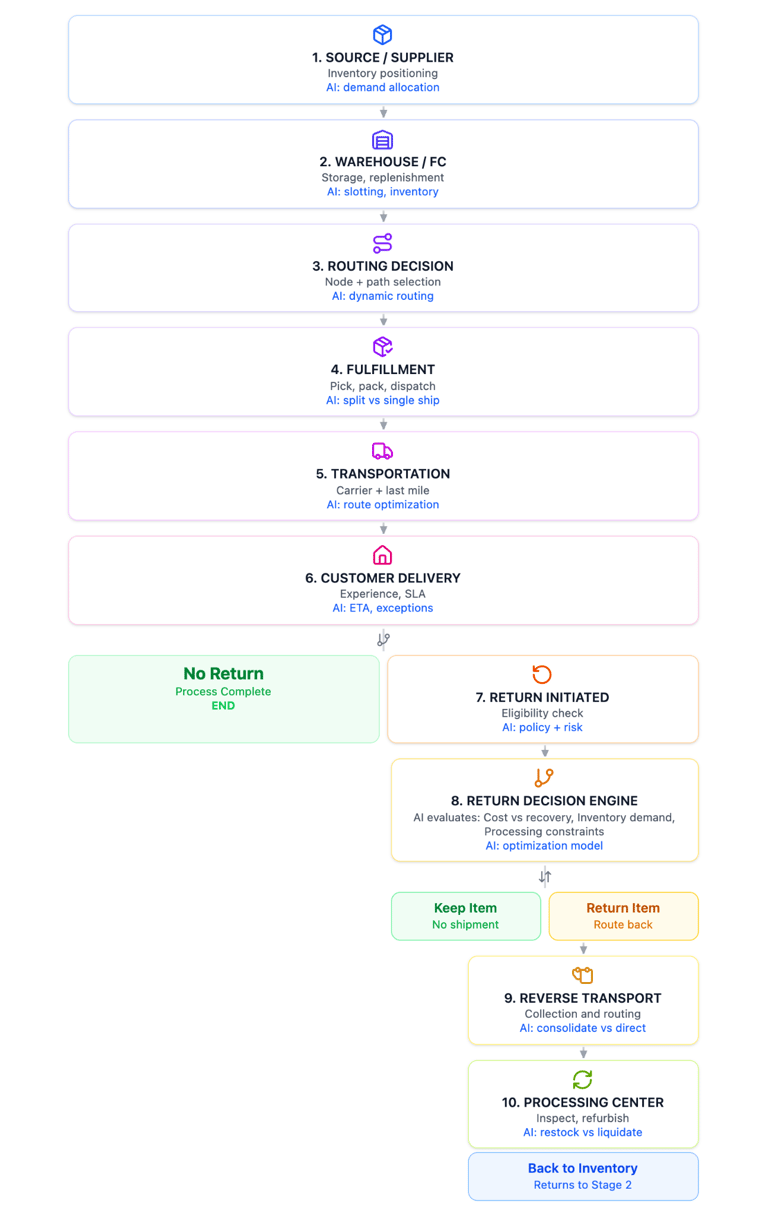
One of the clearest examples of this shift can be seen in how organizations approach returns. Returns are often treated as a reverse logistics problem, but in reality they represent a multi-dimensional decision challenge. Each return requires evaluating eligibility, determining the best destination, and balancing recovery value against operational cost.
Traditional approaches rely on fragmented rules spread across systems. This leads to inconsistent outcomes and missed opportunities to optimize. A more effective approach is to centralize decision making and evaluate multiple possible outcomes in real time. Instead of asking whether a return should be processed, the system asks what the best possible outcome is given the current context.
This context includes factors such as inventory positioning, handling costs, and downstream processing constraints. By evaluating these variables together, organizations can reduce unnecessary shipments, improve recovery rates, and create a smoother customer experience.
Routing decisions present a similar opportunity. Many logistics networks still depend on static rules or limited optimization models. These approaches struggle to adapt to real world variability such as shifting demand patterns or capacity constraints. A more resilient model is to design systems that can adapt continuously. Decoupling different layers of decision making allows each part of the system to evolve independently. This creates flexibility without sacrificing control. Routing decisions can then incorporate real time signals and broader operational considerations, rather than relying solely on predefined paths.
UPS uses AI-driven routing through its ORION system, which continuously evaluates delivery routes based on traffic, package volume, and operational constraints. The system dynamically adjusts routes in real time rather than relying on static plans, improving efficiency and significantly reducing fuel consumption and miles traveled. UPS also uses advanced analytics across its network to improve planning and operational performance.
FedEx has incorporated AI into its logistics network through platforms such as FedEx Surround and SenseAware. These systems use real time data, sensors, and machine learning to monitor shipments, predict potential delays or disruptions, and enable proactive intervention. They provide enhanced visibility and decision support for time sensitive and high value shipments.
The impact of intelligent systems is not limited to core operations. It extends to how engineering teams build and maintain logistics platforms. Modern logistics systems are complex, and diagnosing failures often requires navigating logs, code changes, and dependencies across multiple services.
Intelligent tooling can significantly reduce this burden. By analyzing system signals and identifying likely sources of failure, these tools help engineers focus on resolution instead of investigation. The result is faster recovery, improved reliability, and more time spent on building new capabilities.
There is also growing potential in using AI to accelerate system evolution. Large scale migrations and platform modernization efforts often require significant engineering effort. Intelligent assistance can streamline parts of this process by generating code, suggesting improvements, and reducing repetitive work. This enables teams to move faster while maintaining quality.
A consistent lesson across these areas is that success in logistics does not come from optimizing a single component. It comes from embedding intelligence into the entire decision framework. Every layer, from operational choices to engineering workflows, contributes to overall performance.
At the same time, reliability and accountability remain essential. Logistics decisions have direct financial and operational consequences. Systems must be predictable, auditable, and aligned with clearly defined constraints. The goal is not just smarter decisions, but decisions that can be trusted and explained.
Looking ahead, the role of AI in logistics will continue to expand. As supply chains become more dynamic, the ability to evaluate tradeoffs in real time will become a core capability. Organizations that invest in decision centric systems will be better positioned to adapt, scale, and deliver consistent value.
The future of logistics is not only about moving goods efficiently. It is about making better decisions at every step. AI makes that possible, but only when it is applied with a clear understanding of context, constraints, and outcomes.
~~~ end ~~~
REFEERENCES
UPS (AI driven routing / ORION ). See <here>
FedEx ( AI visibility / prediction / intervention ). See <here>
Disclaimer: The information in this digest is provided “as it is”, by the SAFE AI FOUNDATION, USA. The use of the information provided here is subject to the user’s own risk, accountability, and responsibility. The SAFE AI FOUNDATION and the author are not responsible for the use of the information by the user or reader. The opinions expressed in this article are solely that of the author, not the SAFE AI Foundation. All copyrights related to this article are reserved by the author. Please reference this article if you wish to cite it elsewhere.
Note: The SAFE AI Foundation is a non-profit organization registered in the State of California and it welcomes inputs and feedback from readers and the public. If you have things to add concerning AI Logistics and would like to volunteer or donate, please email us at: contact@safeaifoundation.com