
AI Digest
SEPT / OCT 2026
~ ~ \\ // ~ ~
authored by
Nirmal Jingar
25 MAY 2026
Copyright (C) SAFE AI Foundation
Why Safe AI Architecture Matters for Modern Supply Chains?
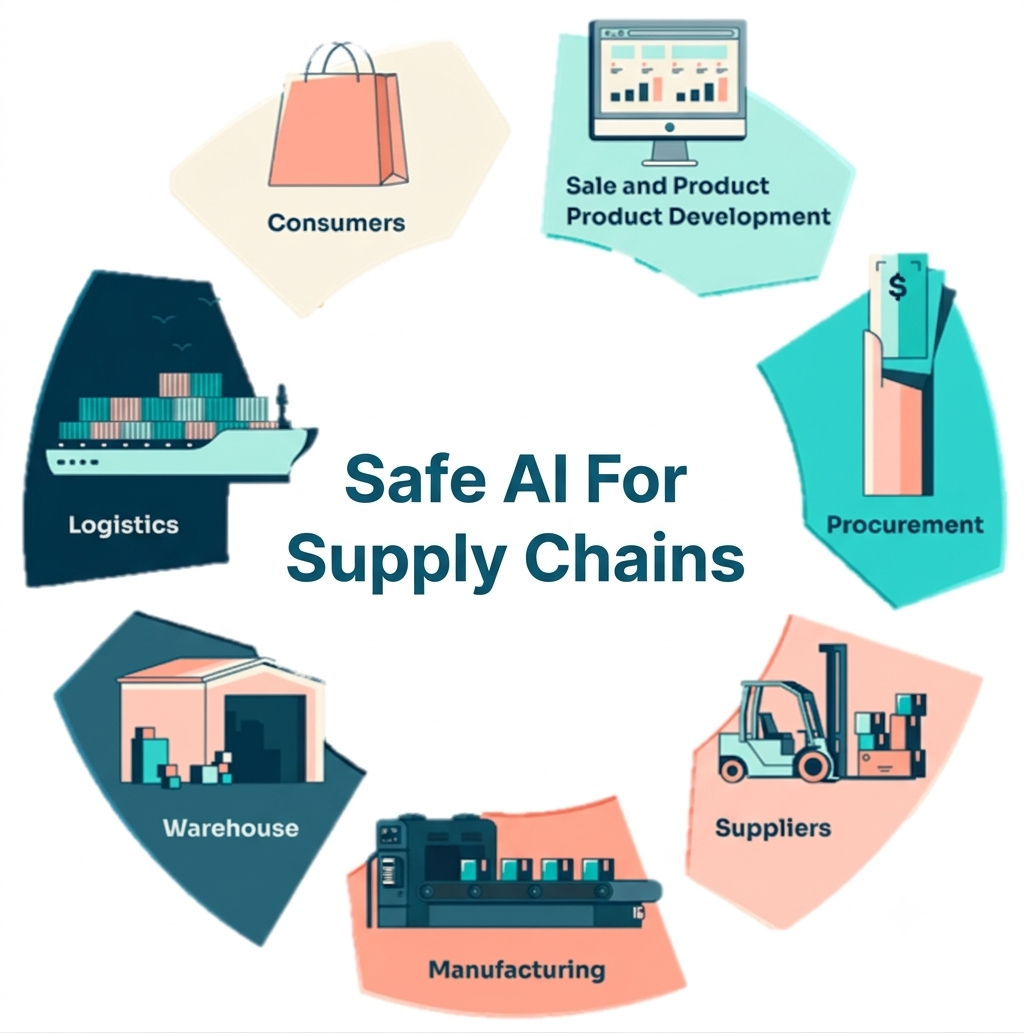
Global supply chains have entered an era where operational volatility is no longer an exception. It is now the normal state of business. Weather disruptions, geopolitical instability, transportation bottlenecks, supplier uncertainty, labor shortages, and rapid demand swings continuously affect enterprise operations.
At the same time, organizations are accelerating the adoption of generative AI and large language models across logistics and operational systems. Many enterprises see these technologies as an opportunity to improve decision making, increase responsiveness, and reduce planning inefficiencies.
The excitement is justified.
Modern AI systems can process massive volumes of operational information across both structured and unstructured sources. They can analyze disruption signals, interpret supplier updates, summarize logistics events, detect emerging patterns, and assist planners in navigating highly dynamic environments. However, there is a fundamental architectural challenge enterprises must solve before AI can safely operate inside critical supply chain systems.
Large language models are probabilistic systems.
Enterprise logistics operations require deterministic control.
That distinction matters.
A conversational error inside a chatbot may create inconvenience. A flawed logistics recommendation inside a fulfillment network can create inventory shortages, transportation instability, compliance failures, and significant financial exposure.
This is why safe AI architecture has become one of the most important challenges in enterprise technology.
The Emerging Reliability Gap in Enterprise AI
Most enterprise AI deployments currently fall into one of two categories:
The first category includes traditional optimization and planning systems used across logistics and supply chain operations. These systems rely on deterministic methods such as forecasting models, optimization engines, routing algorithms, and inventory planning frameworks. They are highly reliable and mathematically controlled, but they often lack the contextual awareness needed to respond quickly to rapidly changing operational conditions.
The second category includes generative AI systems such as copilots, autonomous agents, and conversational decision assistants. These systems are flexible and capable of reasoning across large amounts of information, but they also introduce uncertainty. Hallucinated outputs, inconsistent recommendations, weak explainability, and unpredictable execution behavior create significant operational concerns.
This creates a growing gap between AI intelligence and enterprise reliability. Organizations want systems that can reason dynamically without compromising operational safety. That requires a different architectural approach.
AI Should Support Decisions, Not Unilaterally Execute Them
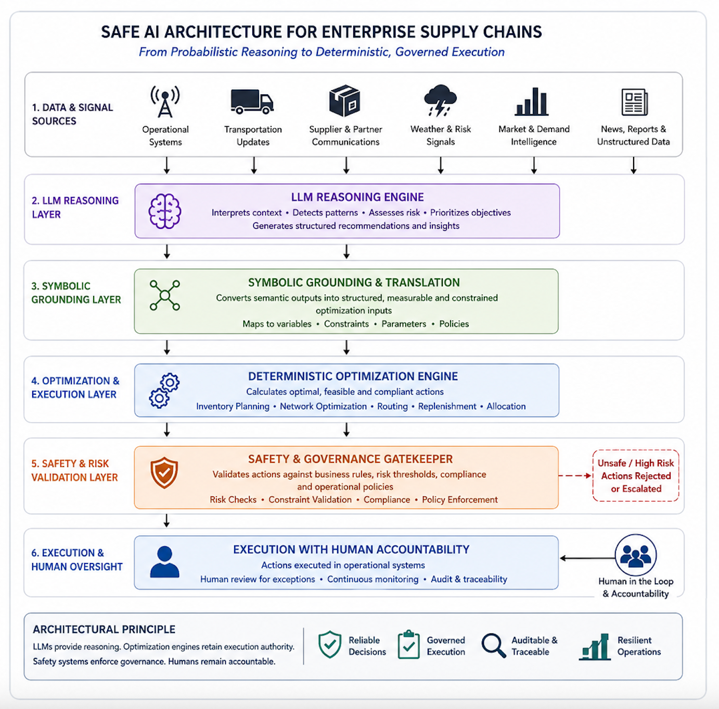
One of the most important principles in safe enterprise AI is the separation between reasoning and execution. AI models can provide valuable operational insight. They can identify disruption patterns, evaluate risk signals, prioritize constraints, and generate recommendations for planners and optimization systems. But AI should not directly control critical operational execution inside enterprise systems without deterministic safeguards.
In logistics environments, this distinction matters because decisions involving transportation, inventory movement, procurement, and fulfillment carry real-world operational consequences. A safe enterprise AI architecture should allow AI systems to contribute contextual intelligence while preserving deterministic control inside execution systems.
Under this model:
AI systems interpret operational conditions
Optimization engines calculate bounded actions
Governance systems enforce policy and compliance
Human operators retain accountability
This creates a layered decision framework where intelligence and reliability coexist.
Operational Interfaces That Matter in Supply Chain AI
One reason enterprise AI systems become risky is that they increasingly interact directly with operational interfaces connected to real-world execution systems.
These interfaces may include:
Transportation Management Systems (TMS)
Warehouse Management Systems (WMS)
Enterprise Resource Planning (ERP) platforms
Carrier APIs
Inventory optimization engines
Procurement systems
Supplier communication platforms
Fulfillment orchestration layers
Robotics and warehouse automation systems
When AI recommendations interact with these systems, even small reasoning errors can propagate rapidly across the entire operational network.
For example:
an incorrect carrier prioritization can delay regional fulfillment, affecting millions of people!
a flawed inventory rebalance recommendation can create stockouts
inaccurate supplier risk interpretation can trigger unnecessary procurement escalation, resulting in financial loss
incorrect demand prioritization can distort allocation decisions during peak periods, resulting in customers' dissatisfaction
This is why safe AI architectures require validation layers between AI reasoning and operational execution interfaces.
Critical Decision Signals in Safe AI Systems
Safe enterprise AI systems should continuously evaluate operational signals before recommendations influence execution workflows. The table below illustrates examples of high-priority operational signals and why they matter inside enterprise supply chains.
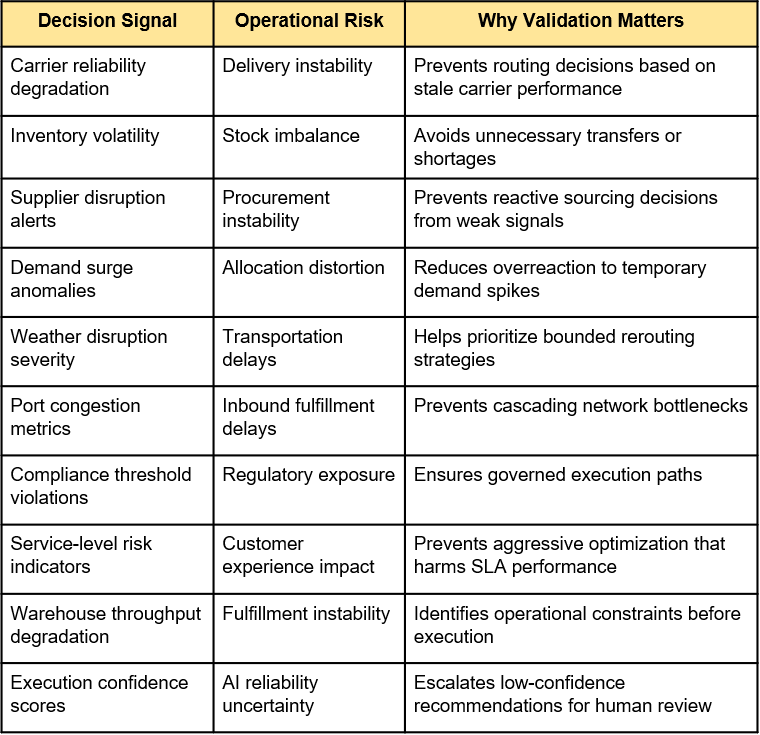
These signals should not independently trigger autonomous actions.
Instead, they should contribute to bounded decision frameworks that combine:
operational telemetry
deterministic optimization
governance constraints
human accountability
Why Grounding and Validation Are Essential
One of the largest risks in operational AI is allowing unconstrained language outputs to directly influence production systems. To safely operationalize AI reasoning, enterprise architectures need mechanisms that convert semantic recommendations into measurable and auditable operational parameters. This process is often referred to as grounding.
Grounding creates a controlled bridge between probabilistic AI reasoning and deterministic enterprise execution. Instead of allowing free-form outputs to drive operational decisions, the system validates and transforms recommendations into bounded optimization constraints and governed execution inputs.
For example:
“reroute inventory aggressively” becomes bounded transfer constraints
“avoid unstable carriers” becomes carrier reliability threshold filters
“prioritize customer experience” becomes service-level optimization weighting
“reduce fulfillment risk” becomes governed inventory allocation policies
This approach becomes especially important in industries where enterprises must manage:
operational risk
compliance obligations
service-level guarantees
transportation constraints
financial exposure
customer commitments
Without governance boundaries, AI systems can generate operational recommendations that appear plausible while introducing hidden risk.
Safe AI architectures must prevent that from happening.
Safety Must Become a Core Architectural Layer
Many enterprise AI discussions still focus primarily on productivity and automation. Far fewer discussions focus on operational safety. That imbalance creates long-term risk. As organizations increase the use of AI inside logistics and operational workflows, safety mechanisms can no longer remain secondary controls. They must become foundational architectural components.
In high-scale supply chains, safe AI systems should continuously evaluate factors such as:
disruption severity
transportation instability
inventory volatility
compliance thresholds
service-level risk
execution confidence
Actions that exceed acceptable operational thresholds should be blocked, escalated, or routed for human review before execution occurs. This creates operational guardrails that preserve enterprise trust while still allowing organizations to benefit from AI-assisted intelligence.
A Realistic Enterprise Scenario:
Consider a retail logistics network operating during peak seasonal demand.
A severe weather event disrupts transportation corridors across multiple regions. Port congestion delays inbound inventory movement while carrier reliability deteriorates simultaneously. Demand patterns begin shifting rapidly across fulfillment nodes. Traditional planning systems often struggle under these conditions because they rely heavily on static assumptions and delayed updates. A safe AI-enabled architecture can help organizations respond more intelligently.
AI systems can continuously analyze disruption reports, carrier updates, demand changes, supplier communications, and operational telemetry in real time. The system can identify elevated transportation risk, recommend inventory protection strategies, highlight unstable fulfillment paths, and prioritize operational constraints. However, final execution decisions should still remain governed by deterministic optimization systems and safety validation layers.
This distinction is critical. The objective is not unrestricted autonomy. The objective is resilient operational intelligence with bounded risk. The Future of Enterprise AI Depends on Trust The next phase of enterprise AI adoption will not be defined solely by larger models or more autonomous agents. It will be defined by trust.
Organizations need AI systems that are reliable, explainable, governable, and operationally safe. Enterprises cannot deploy probabilistic systems into critical operational environments without measurable safeguards and deterministic oversight. This is particularly important in logistics and supply chain operations where operational failures can cascade rapidly across global networks.
The future of safe enterprise AI will likely depend on architectures that combine:
contextual AI reasoning
deterministic execution
operational governance
safety-aware orchestration
measurable reliability controls
Enterprises that solve this challenge successfully will be better positioned to deploy AI at scale while preserving operational confidence and customer trust.
The long-term future of enterprise AI will belong to organizations that prioritize reliability as much as intelligence.
~~~ end ~~~
REFEERENCES
Jingar, N. K. (2026). Reliable LLM-Powered Decision Engines for Large-Scale Supply Chain Operations: Architecture, Safety, and Performance Guarantees. IEEE IC_ASET 2026. https://doi.org/10.1109/IC_ASET69920.2026.11502212
Disclaimer: The information in this digest is provided “as it is”, by the SAFE AI FOUNDATION, USA. The use of the information provided here is subject to the user’s own risk, accountability, and responsibility. The SAFE AI FOUNDATION and the author are not responsible for the use of the information by the user or reader. The opinions expressed in this article are solely that of the author, not the SAFE AI Foundation. All copyrights related to this article are reserved by the author. Please reference this article if you wish to cite it elsewhere.
Note: The SAFE AI Foundation is a non-profit organization registered in the State of California and it welcomes inputs and feedback from readers and the public. If you have things to add concerning the impact of AI on Supply Chains and would like to volunteer or donate, please email us at: contact@safeaifoundation.com