AI Digest
JANUARY 2026
~ ~ \\ // ~ ~
authored by
Chai K Toh
08 JAN 2026
Copyright (C)
SAFE AI Foundation
'Digital Immortality: AI & Digital Self'
- The Day When You Will Never Actually Die...
Intro – To usher in the new year 2026, I am covering on a futuristic topic that not many people have talked about. In the “AI Manifestation Unfolded” doctrine that I wrote, I have mentioned the point on humans’ desire for self-preservation and digital immortality. This desire is not only for the rich and powerful but also likely for everyone. In this digest, I will go deeper into this subject, to get us ready on what is about to come next.
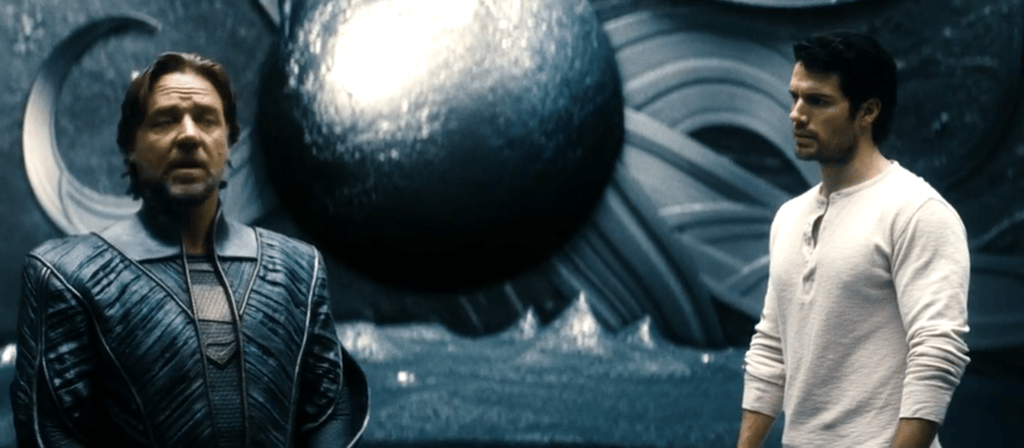
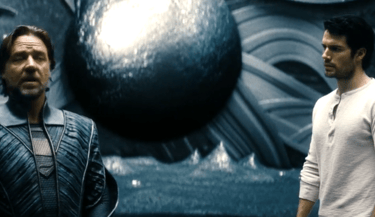
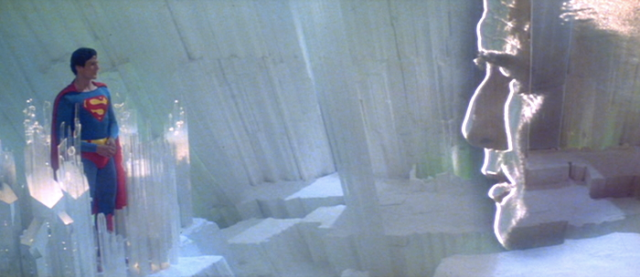
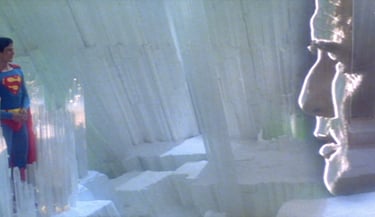
Many of us have seen the movie SUPERMAN, and in one episode, Kal met and spoke to Jo-El, his deceased father, who appeared "alive" as a "shadow image" and talking intelligently with Kal. An earlier version showed a digital image of superman's father, while a later version show a more human-like image. See figures (sources Warner Brothers Studios) below.
FEAR of Death – Everyone has to face death at some point in time. This applies to both the rich and poor. Some humans, despite having an average life span of 80 years and being able to experience the various stages of their lives, are still not contented. Some billionaires and those holding power would like to live longer, if not, forever. This may explain the sudden surge in longevity research. However, current advances in medical sciences have not achieved the level needed for human immortality. Humans will still age and die. Hence, instead of a BIOLOGICAL approach, some have proposed a DIGITAL approach.
By DIGITAL SELF, I refer to having a digital representation of oneself. Think of this as a DIGITL SELF (DS). After a human dies, its DS takes over and is able to interact with families and humans. This DS can exist within a CHATGPT or humanoid robot or present itself as a hologram image. With the provision of wireless communications and the Internet, this digital self can go wherever it wishes to go to. Also, it can be summoned as and when it is needed or it can be carried as a device residing in a pocket. While some fancy that this digital self is a form of immortality, it is debatable the meaning of such an existence. Some would think this could comfort families, as the voice and images are preserved for generations to come. However, some have said that this causes continual pain (of losing someone) as the feel and touch is still missing. While this digital self provides some form of comfort and companionship, some still view it as an illusion.
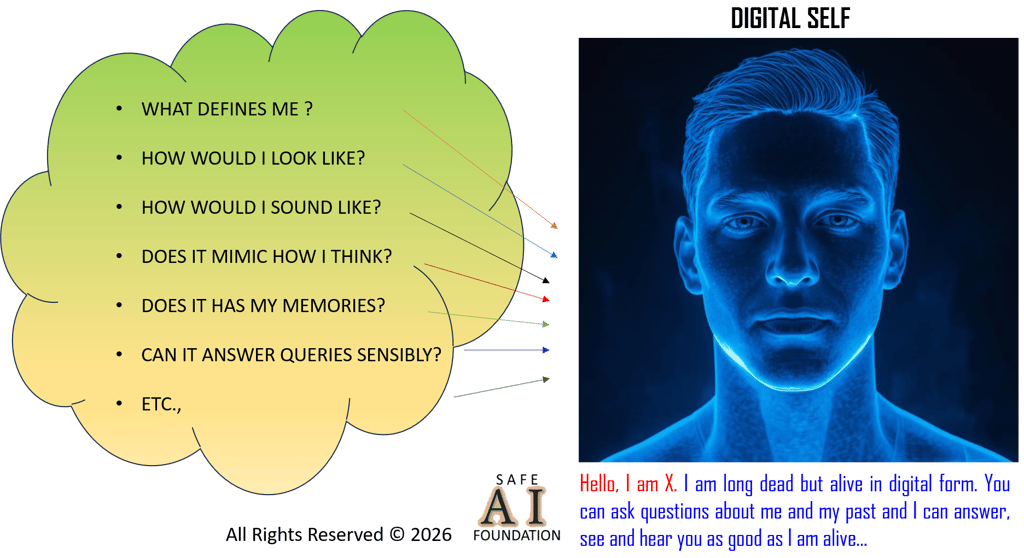
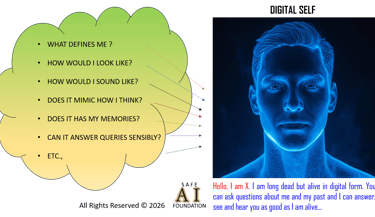
Tracing Roots & Legacy - Digital self can rewrite history. Families can now retain and archive all their families members, so that future generations can know their roots, ancestries, their lives, wisdom and knowledge. Families can pass digital selves from one generation to another. World governments can consider if they wish to preserve digital selves of their citizens in their nations.
Digital Self can Rewrite History !!
Technical Challenges and Role of AI in Digital Self – Extracting one’s image and voice is easy. Current voice and image capture, encoding and decoding will do the trick. Synthesizing voice using electronic means is achievable. Converting text to voice is doable. Listening is possible through voice (via microphone) or text inputs (keyboards). Hence, with an underlying conservational AI, it would mean that a digital self can be achieved.
One can even talk to a digital self, be impressed, intrigued, disgusted or impersonated by it. Extracting the memories of the person before he/she dies and transferring them to this digital self would be a challenge. There are things or bad memories where the person does not want others to see or know – the private things – and how can these be filtered? Privacy must still be respected, even after death. Currently, we are still unable to extract the brain contents and store them in a digital form before or after the person dies. If we cannot extract it, we cannot filter the contents.
Assuming that we cannot extract memories, then we may be left with the choice of imparting “permissible” memories to the digital life before one dies. This means that we can choose what it (the digital self) can remember and what we want future generations to see , know, and understand us as a person. This is a form of “training”, educating the digital self about oneself.
AI Training of a Digital Self is about learning within permissible boundaries.
Until one is satisfied that the digital self so created with the help of AI largely represents oneself and is safe, he/she can sign off as an authorized digital self to be used or invoked after he/she dies. This consent must be given before the digital self is launch and put to use. There will be others who do not wish to have a digital self and choose to be gone for good, peacefully. The choice is, therefore, yours.
Meaning of Life – Suppose this “digital self” initiative is being pushed forward by billionaires, rich and big corporations and allowed by the government, we will still need to re-examine the consequences, the meaning of life and that of our existence. Humans come with emotions, feelings, attachments, and conscious. We do not kill or hurt others unnecessarily. We seek peace, knowledge, love and adventures. All these characteristics make us who we are. Despite a “given” life-span of 70 – 100 years, human have always stay positive and bravely live till the very last day, and passing on whatever they have to their loved ones, be it knowledge, experiences, wealth or sweet memories. Humanity has persevered through generations after generations. This explains why we have ancestries, we have history. By having a digital self after one’s death, will that change how we view life? Is this the way we choose to remember our love ones? A digital self instead of a photo or a diary? Do we want our children to grow up remembering their grandparents only in digital forms? Hence, we need to convince and justify ourselves the need for digital self.
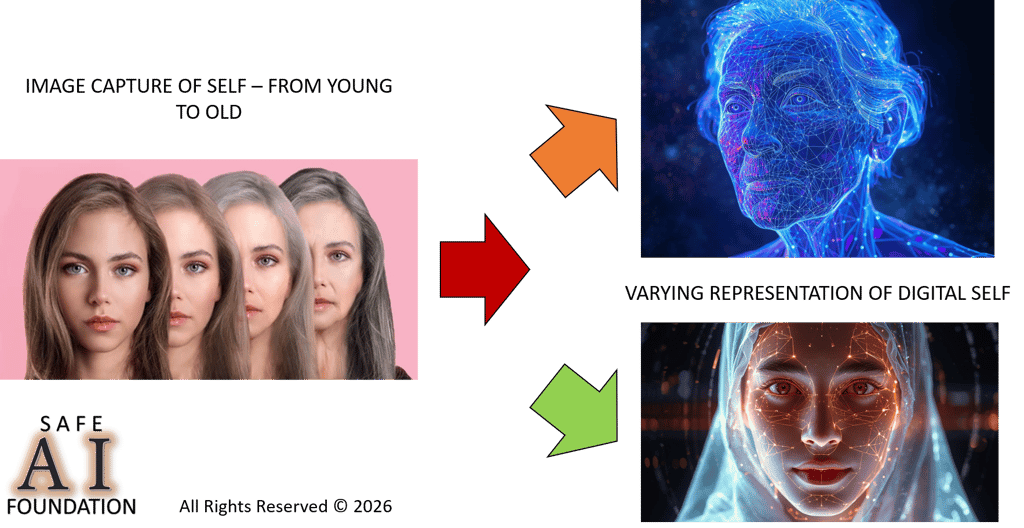
Self-deception - Do we want to “cheat” ourselves that our loved ones have not passed away and we are still emotionally reliant on and attached to them? Or is the dying person trying to convince himself that he is not dead, simply because he has transformed from a human being to a digital form, a digital self? Does this self-deception of non-human existence carry any real meaning? Does this symbolize that we are too weak to face death? These and many more are questions that we need to answer and clarify, before we jump on to develop and permit the roll out of digital selves. For the good part, we can see our loved ones and hear their voices, offering us comfort and companionship.
Digital Self versus Avatar - A lot of us are familiar with personal avatars, where a cartoon-like or digital figure of us appearing in another virtual world of another dimension. An avatar provides duality of the person, where one exists in the physical world while the other (the avatar) in the virtual world. Duality implies that the physical person is still alive and it is he/she who operates to enter into the virtual world (usually through an AR Goggle). There also exists physical interaction - from hand and head movements to speech. Hence, this is different from digital self (DS) since DS is usually invoked after one's death. However, it is still possible for DS to co-exist in the same time as the physical person but operating within boundaries to avoid conflicts, misrepresentations, fraud, etc. A DS is not a physical person and cannot hold the same legal status and rights as the real person. In essence, an avatar is not similar to a DS. An invoked DS does not need physical operation by the person concerned and has fuller autonomy (once invoked) than an avatar.
Remaining questions - There are lots more questions than answers for the digital self and digital immortality.
Will our future be full of digital selves?
What roles will AI play in the construction of digital selves?
Will we remember our ancestors mainly by interacting with their digital selves?
Will we be able to still stay "human" by showing more compassion, love and increase our desire for forever peace?
Can the digital self offer comfort to the loved ones who have lost their family members?
Will friends have accessed to digital selves of those who have passed away or DSs are only restricted to family members?
Will we allow duality to exist, i.e., a living person and his digital self both existing at the same time and space (not after death) and if so, for what purpose and will there be contradictions or conflicts?
The world of digital self may start off in small numbers, until it gradually gains acceptance and popularity. Every individual must retain the ultimate right to have or not have a digital self. Ownership and possession of other digital selves must conform to specific requirements, legal and inheritance protocols. AI can largely improve the closeness and intelligence of digital self to the respective person concerned. The higher the realism, the better the digital self can represent that individual. In this way, a human bloodline history can be accurately traced, kept, bypassing the limitation of three generations (grandparents, self, children). Perhaps, instead of passing on wealth, knowledge, documentations of one's existence, with digital selves, one can now trace and keep record of one's family and ancestry for a very long time.
~~~ end ~~~
Disclaimer: The information in this digest is provided “as it is”, by the SAFE AI FOUNDATION, USA. The use of the information provided here is subject to the user’s own risk, accountability, and responsibility. The SAFE AI FOUNDATION and the author are not responsible for the use of the information by the user or reader. All copyrights are reserved by the SAFE AI Foundation. Please reference this article if you wish to cite it elsewhere.
Note: The SAFE AI Foundation is a non-profit organization registered in the State of California and it welcomes inputs and feedback from readers and the public. If you have things to add concerning AI, Digital Self, Digital Immortality or would like to volunteer or donate, please email us at: contact@safeaifoundation.com